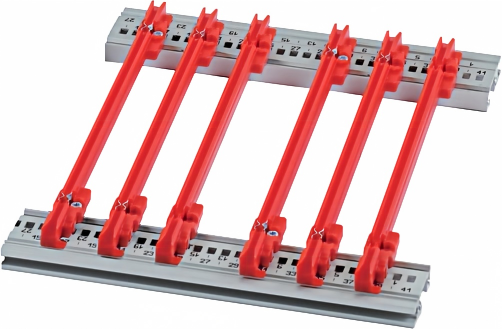
A 19-inch subrack may look like a simple metal frame, but the performance and serviceability of the system depend on many smaller parts inside it.
PCB guide rails need to hold the boards at the correct position. Front panels need to fit the chassis accurately. Handles must allow reliable insertion and removal. Horizontal rails provide structural support, while EMC gaskets and grounding clips help maintain shielding and electrical continuity.
When an electronic system has been in service for years, these small components can become a problem.
The original part may be discontinued. The OEM price may be too high. The supplier may require a large minimum order. Or the original component may simply be difficult to identify.
This is where understanding 19 inch subrack parts and components becomes important.
What Is a 19 Inch Subrack?
A 19 inch subrack is a modular mechanical structure used to house electronic assemblies such as PCBs, Eurocards and other plug-in modules.
The 19-inch architecture provides a common mechanical framework, but the components inside the subrack can vary considerably depending on the equipment design.
A typical system may contain:
- PCB guide rails
- Front panels
- Card handles
- Extractor handles
- Horizontal rails
- Mounting brackets
- Threaded inserts
- Screws and fasteners
- EMC gaskets
- Grounding clips
- Support rails
- Backplane-related components
Therefore, when someone searches for 19 inch subrack components, they may not be looking for the complete chassis. They may only need one small component to repair or maintain an existing system.
That distinction is important for both engineers and purchasing teams.
What Are 19 Inch Subrack Parts?
19 inch subrack parts are the individual mechanical, structural and functional components used inside or around a 19-inch subrack.
Some are standard components. Others are manufactured specifically for a particular chassis.
The most common groups include:
PCB Guide Rails
PCB guide rails keep electronic boards aligned during insertion and removal.
They are commonly used with Eurocard-type systems and other modular PCB assemblies.
The important specifications are not just the overall length. Buyers may also need to check:
- PCB thickness
- Groove width
- Rail length
- Mounting method
- Hole position
- Material
- Front/rear configuration
- Board insertion position
A guide rail that looks almost identical to the original may still be unsuitable if one of these dimensions is different.
Front Panels
Front panels close the front opening of the subrack and provide the interface between the electronic module and the outside environment.
Depending on the application, a panel may include:
- Handle holes
- Connector cutouts
- Switch openings
- Indicator openings
- Ventilation holes
- Engraving
- Printing
- EMC contact features
3U and 6U configurations are common in modular electronic systems.
For replacement projects, the panel can often be manufactured from an existing drawing, sample or accurate measurements.
Handles and Extractor Handles
Handles make it easier to install and remove plug-in electronic modules.
Some applications use simple handles, while others require injector/extractor mechanisms that provide mechanical assistance during insertion and removal.
The mounting location, hole pattern and handle geometry need to match the PCB or front panel.
Horizontal Rails
Horizontal rails form part of the structural framework of the subrack.
Depending on the design, rails may be positioned at the front, middle or rear of the chassis.
When sourcing a replacement, check:
- Length
- Profile
- Hole spacing
- Thread specification
- Material
- Surface treatment
- Mounting position
This is particularly important for older equipment because visually similar rails can have different hole patterns.
Subrack Accessories: The Small Parts That Make the System Work
The term 19 inch subrack accessories covers a wide range of components that support the main mechanical structure.
These may include:
- Card guides
- Handles
- Front-panel hardware
- Mounting brackets
- EMC gaskets
- Grounding clips
- Threaded inserts
- Screws
- Support rails
- Fasteners
- Cable-management components
In many maintenance projects, the customer does not need a complete new subrack.
They need one missing or discontinued accessory.
For example:
“The equipment is still working, but the original PCB guide rail is no longer available.”
Or:
“We need 50 replacement front panels for an older electronic system.”
Or:
“The original EMC gasket is discontinued. Can we use another material with the same installation dimensions?”
These are typical subrack component replacement requirements.
Subrack Components vs. Electronic Enclosure Components
The terms subrack components and electronic enclosure components are related, but they are not always the same thing.
An electronic enclosure may be a standalone box designed for a specific application.
A subrack is usually part of a modular system where boards, panels, rails and other components work together.
For example, an electronic enclosure may require:
- Enclosure panels
- Covers
- Hinges
- Locks
- Mounting brackets
- Cooling components
A modular 19 inch subrack may additionally require:
- PCB guide rails
- Front panels
- Card handles
- Horizontal rails
- Backplane support
- EMC shielding
- Grounding components
This is why a general enclosure component is not automatically suitable for a 19-inch subrack.
The mechanical interface has to be checked.
19 Inch Chassis Components: What Should You Check?
A 19-inch chassis may contain dozens of individual components.
When replacing one of these 19 inch chassis components, start with the mechanical interface rather than the product name.
Five things are particularly important.
1. Dimensions
Measure the original component carefully.
For small mechanical parts, a difference of only a few millimeters can prevent installation.
2. Mounting Holes
Check:
- Hole diameter
- Hole spacing
- Hole position
- Countersink or counterbore
- Thread type
3. Material
Common materials may include:
- Aluminum
- Steel
- Stainless steel
- Engineering plastics
- Die-cast alloys
The correct material depends on the mechanical, electrical and environmental requirements.
4. Surface Treatment
The same base material can behave differently depending on its surface finish.
Depending on the component, treatments may include:
- Anodizing
- Conversion coating
- Plating
- Passivation
- Painting
- Powder coating
Surface treatment can affect appearance, corrosion resistance, conductivity and EMC performance.
5. Function
Finally, check what the component actually does.
A guide rail is not simply a piece of plastic.
An EMC gasket is not simply a strip of material.
A grounding clip is not simply a spring.
The replacement needs to reproduce the required function as well as the dimensions.
What Is Subrack Hardware?
Subrack hardware generally refers to the smaller fastening and mounting components used to assemble the system.
Examples include:
- M2.5 screws
- M3 screws
- M4 screws
- Threaded inserts
- Nuts
- Washers
- Mounting clips
- Brackets
- Captive screws
- Fastening accessories
These parts are inexpensive individually, but they can become surprisingly difficult to source when the original equipment is obsolete.
For long-running equipment, even a discontinued screw, insert or mounting bracket can delay maintenance.
This is why many equipment manufacturers keep detailed mechanical drawings and replacement-part records for their systems.
19 Inch Rack Components Are Not Always Subrack Components
Another common source of confusion is the difference between 19 inch rack components and 19 inch subrack components.
A 19-inch rack generally refers to the larger rack or cabinet structure used to mount equipment.
A subrack is a modular chassis structure installed within an equipment system.
They may share the same nominal 19-inch architecture, but their mechanical requirements can be completely different.
For example:
19 inch rack components may include:
- Rack rails
- Rack shelves
- Cable-management accessories
- Rack panels
- Cabinet hardware
While subrack components may include:
- PCB guide rails
- Front panels
- Card handles
- Horizontal rails
- EMC gaskets
- Grounding clips
- Board support components
Before purchasing, confirm whether you need a rack accessory or an actual subrack component.
How to Identify an Unknown Subrack Part
This is one of the most common problems in legacy equipment.
You may have a component in your hand but not know its exact name.
In that situation, you do not necessarily need to identify the official product name first.
Start with the physical information.
Send the supplier:
1. Photos
Take clear photos from several angles.
2. Dimensions
Measure length, width, height, hole diameter and hole spacing.
3. Part number
Look for markings, labels or stamped numbers.
4. Material
If known, provide the material specification.
5. Application
Explain where the component is installed.
6. Quantity
The required quantity helps determine the most suitable manufacturing method.
7. Original drawing
If available, provide the 2D or 3D drawing.
This information is usually enough for a manufacturer to begin evaluating a replacement.
How to Replace Discontinued 19 Inch Subrack Parts
A common situation looks like this:
The equipment is still working. The mechanical component is not.
Replacing the complete electronic system may be unnecessary.
Instead, the maintenance team can investigate whether the mechanical component can be reproduced or replaced.
The process can be:
Original Part → Identify Dimensions → Confirm Material → Check Interface → Prototype → Test Fit → Production
For example, an old PCB guide rail can be reproduced if the supplier has sufficient information about its length, groove, mounting method and material.
The same approach can be used for:
- Front panels
- Horizontal rails
- Handles
- Mounting brackets
- EMC gaskets
- Grounding clips
- Other electronic chassis parts
This approach can be particularly useful for equipment that has been operating for 10, 15 or even 20 years.
OEM Parts or Compatible Alternatives?
When the original manufacturer is still supplying the component, purchasing the OEM part may be straightforward.
But that is not always the situation.
The original part may be:
- Discontinued
- Expensive
- Subject to long lead times
- Available only in large quantities
- Difficult to source
- No longer supported
A compatible alternative can provide another sourcing option.
However, “compatible” should not simply mean “looks similar.”
The replacement should be evaluated against the original requirements:
| Item | What to Compare |
|---|---|
| Dimensions | Length, width, height |
| Mounting | Holes, threads, fixing method |
| Material | Aluminum, steel, plastic, etc. |
| Surface finish | Anodizing, plating, coating, etc. |
| Function | Mechanical or electrical function |
| Interface | PCB, panel, rail or chassis interface |
| Environment | Temperature, vibration, corrosion |
| EMC | Shielding and grounding requirements |
This is particularly important when looking for alternatives to components originally supplied by established enclosure and subrack manufacturers.
Why China Is an Option for Custom Subrack Mechanical Parts
For standard components, buyers may already have several established suppliers.
The situation can be different when the requirement is:
“We need a part that is no longer available.”
China has a broad manufacturing base covering CNC machining, sheet metal fabrication, stamping, extrusion, injection molding, die casting and surface treatment.
This makes China a potential sourcing location for custom subrack parts and low-to-medium-volume replacement components.
For example, a custom front panel may involve:
Aluminum sheet → CNC machining → Bending → Surface treatment → Printing → Inspection
A custom guide rail may require a different manufacturing route depending on its material and geometry.
For purchasing teams, the key issue should be the complete sourcing result rather than simply unit price.
Consider:
- Part quality
- Dimensional consistency
- Material traceability
- Sample approval
- Production capability
- MOQ
- Lead time
- Inspection
- Packaging
- Communication
A reliable replacement supplier should be able to work from drawings, samples, dimensions or photographs rather than only selling catalog products.
Where Are 19 Inch Electronic Enclosures and Subrack Components Used?
19 inch electronic enclosures and modular subrack systems are used in many types of electronic equipment.
Typical applications include:
Railway Electronics
- Train control
- Communication systems
- Ethernet switches
- Passenger information systems
- Signaling equipment
- On-board electronics
Industrial Automation
- Industrial controllers
- Data acquisition
- Measurement systems
- Control systems
Automated Test Equipment
- Test instruments
- Modular measurement systems
- ATE platforms
- Electronic test equipment
Telecom
- Communication equipment
- Network systems
- Transmission equipment
- Industrial networking
Power and Energy
- Power monitoring
- Protection systems
- Control equipment
- Grid-related electronics
These applications can require different combinations of electronic enclosure components, subrack hardware and subrack mechanical parts.
What Should You Ask a Subrack Parts Supplier?
Before placing an order, ask the supplier several practical questions.
Can you work from my original drawing?
This is important when replacing a discontinued component.
Can you manufacture from a physical sample?
Useful when no original drawing exists.
Can you provide a prototype?
A sample or first article allows the customer to verify fit before mass production.
Can you match the original material and surface treatment?
This matters for both mechanical performance and appearance.
Can you handle small quantities?
Many replacement projects do not require thousands of pieces.
Can you inspect critical dimensions?
Dimensional inspection is especially important for components that must fit an existing chassis.
Can you develop a compatible alternative?
This is useful when the original component is no longer available.
How to Order the Right 19 Inch Subrack Parts
If you are looking for a 19 inch subrack part, the easiest way to start is not always by searching for the exact product name.
Instead, provide the information you already have.
You can send:
Part number + drawing + dimensions + photo + quantity
Even if some information is missing, a clear photo and several key dimensions can be a useful starting point.
For older equipment, a physical sample can be even more valuable.
The goal is to identify the actual mechanical interface and function, then determine whether the requirement can be met by:
- A standard component
- A compatible replacement
- A modified standard component
- A fully custom component
Need 19 Inch Subrack Parts?
Finding a small replacement component should not require replacing an entire electronic system.
If you are looking for 19 inch subrack parts, subrack accessories, electronic chassis parts, PCB guide rails, front panels, EMC components, handles, horizontal rails or mounting hardware, provide the original part number, drawing, dimensions or photos.
SubrackParts can evaluate the mechanical requirements and help identify a suitable replacement or develop a custom alternative.
Send Us Your Part Number, Drawing or Photo
Original part number? Send it.
Drawing available? Send it.
No drawing? Send photos and dimensions.
Part discontinued? Tell us what equipment it is used in.
We can help you determine the most practical replacement option for your 19 inch subrack system.